
Hello from Malawi! I have just finished my first week here at the Lilongwe Wildlife Centre in Lilongwe, Malawi. Lilongwe is the capital of Malawi and the second largest city. The economic center is Blantyre which is in the southern part of the country. Malawi is bordered by Zambia to the west, Tanzania to the northeast, and Mozambique to the south. The currency is Kwacha, and 1 US dollar is equivalent to about 800 Kwacha now. The most common native language is Chichewa, spoken by the Chewa people. The official language is English and many of the secondary schools and universities are taught in English. Some Chichewa words are below:
Hello: Moni
Goodbye: Bayi
Please: Khalani bwino
Thank you: Zikomo
Good morning: m’mawa wabwino
How are you?: Muli bwanji
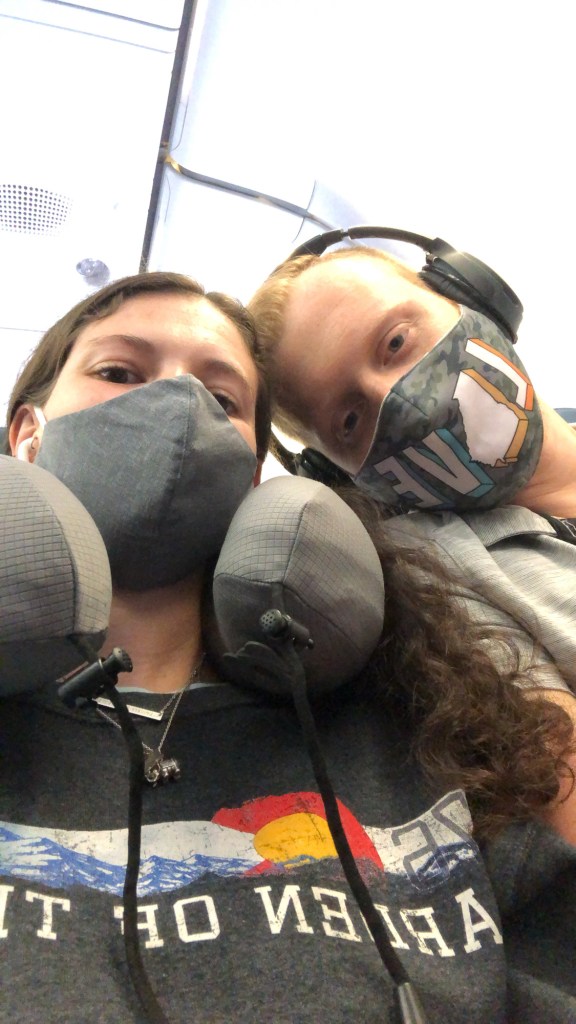
We had quite a long journey from Atlanta to Malawi. We left Atlanta on Saturday, May 22 to fly to New York (JFK). Due to timing issues, we stayed the night with a friend in Manhattan before embarking on our long flight Sunday afternoon. We then flew from JFK to Nairobi, Kenya where we had a 19-hour layover overnight. The flight was 14 ½ hours plus a 7-hour time change so we arrived Monday morning. We got a hotel room close to the airport so that we could rest and recharge before our final leg. Tuesday morning, we flew from Nairobi to Lilongwe, Malawi. We got our visas and were picked up by the center.
Lilongwe Wildlife Centre is one of the sectors of the Lilongwe Wildlife Trust. The Trust was created to battle the issues facing wildlife in Malawi and to help orchestrate change through government policies. These issues aren’t unique to Malawi but every country’s government and policy handles wildlife issues differently, so they have to be tailored to the individual country and its needs. The Trust has four main sections where it focuses its work: wildlife care and rehabilitation, education, law/legislation, and policy. They have been recognized for their work to implement new government policies to protect wildlife and their habitats.
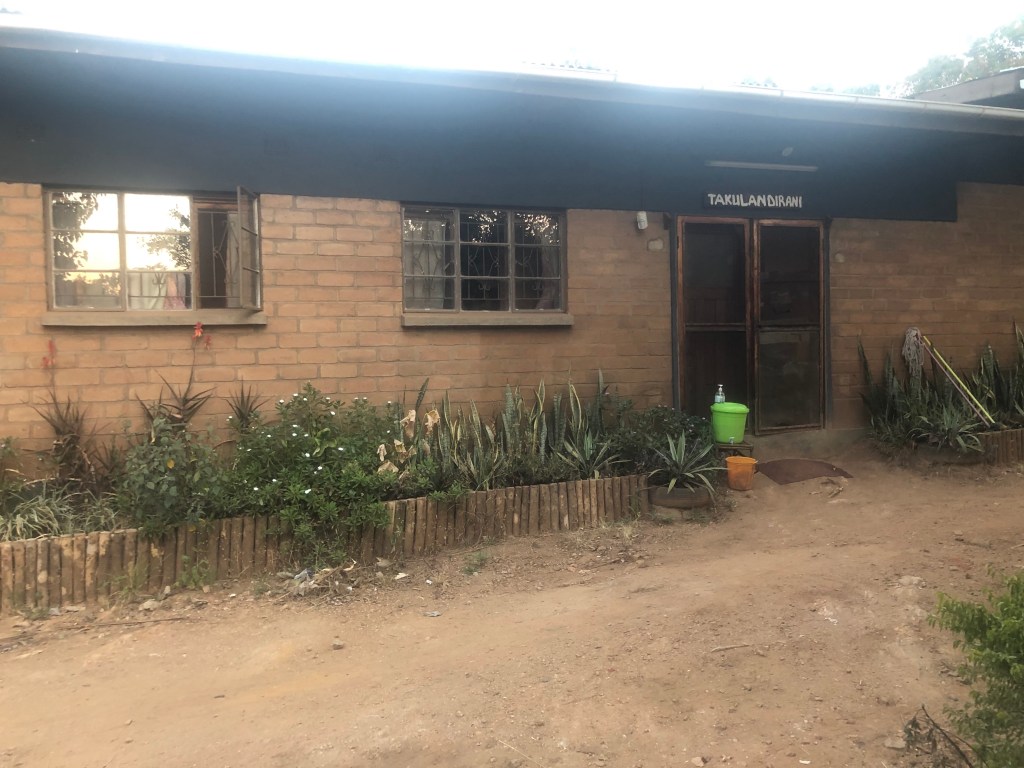
While here, we are volunteering as vet externs. This means that our main duties are to observe and assist Dr. Charlotte Bentley with any veterinary procedures that occur while we are here. We will also be given lectures and labs related to wildlife medicine, husbandry, and other techniques. Dr. Charlotte completed her veterinary degree at the University of Edinburgh in 2017. She worked in a private practice for 3 ½ years following her graduation where she was head of exotics. In 2019, she made her first trip to Lilongwe Wildlife Center. She was supposed to be here full-time starting in 2020 but COVID delayed that until January. She has been here full-time since then. Besides veterinary work, since it is unpredictable and not constant, we will be helping with animal care for the resident animals. The center is home to many baboons and vervet monkeys. They also have samango monkeys, owls, African grey parrots, a serval, and a bushbaby. Most of these animals are only here for rehabilitation and the goal is always to release them. However, it is a very long process to release some of these animals, especially the primates. Baboons and vervets have to be in a large troop before they can be released and survive. This is unfortunate because they don’t want more animals to be brought into the center, but they need more animals to have a group that can go for release.
Wednesday 5/26
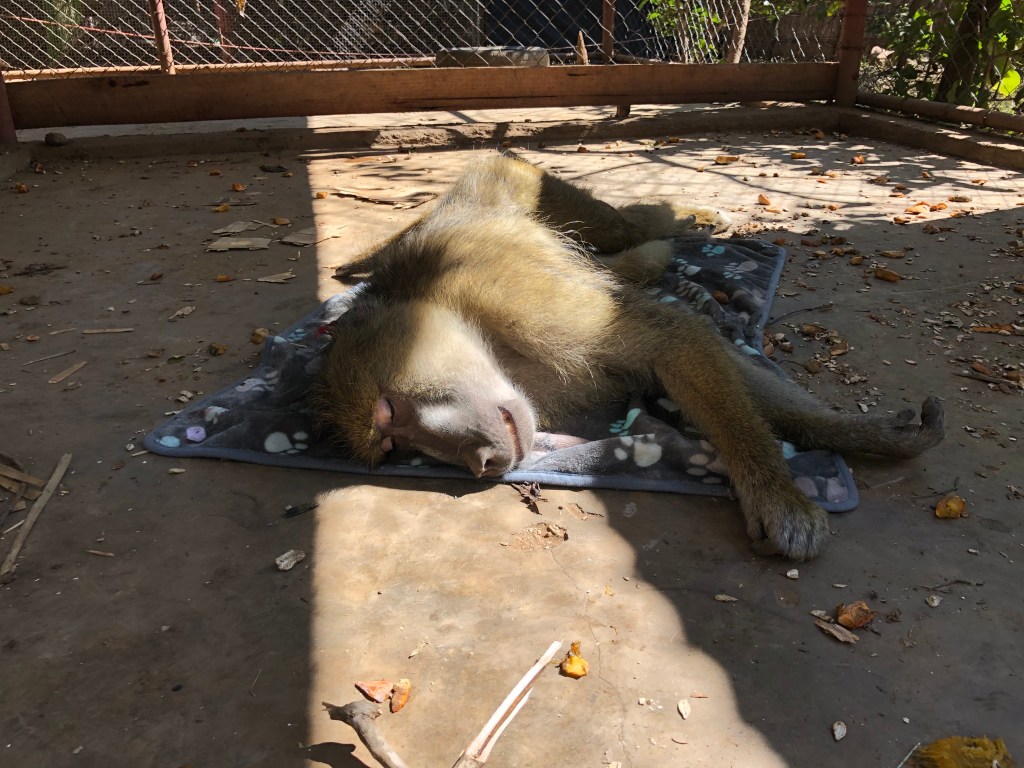
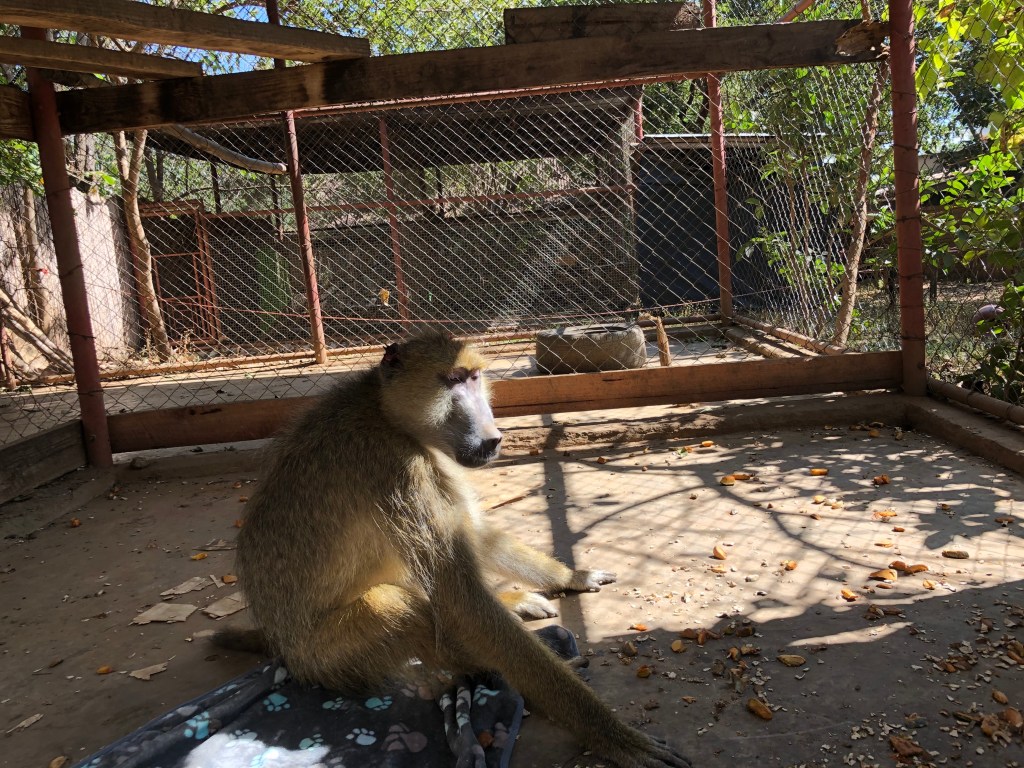
Today was our first full day of work at the center. It was mostly a day of introductions to what we would be doing and how everything should be done. We started with the animals that are on long-term medications. Boudicca is a yellow baboon who came in as an ex-pet. She is blind due to cataracts in both eyes from some vitamin deficiencies. She is being treated with multivitamins to try to help reduce the cataracts. Cataracts can be painful due to the pressure that they can cause in the eyes. When she first came in, she was rubbing her eyes frequently but with the vitamin supplementation, she seems to be more comfortable. Popcorn is a vervet monkey who got into a fight with another monkey in her troop and was bitten on the hand. The injury was significant, and Dr. Charlotte had to amputate one of her fingers. She is healing very well now and is just on anti-inflammatories to help reduce any swelling or pain to promote further healing. The final long-term case is Ronnie. He is a very old vervet monkey who is on anti-inflammatories and multivitamins to keep him pain free and healthy in his old age. After we finished distributing the medications, we helped clean and organize the orphan care area. This area is where we prep all the food and bottles for the resident animals and orphan animals. The orphans are housed with foster moms to give them the natural social interaction that primates need to thrive.
After lunch, we were introduced to enrichment with Gideon. Enrichment is used by most places that house wild animals in captivity to prevent boredom and stress. These animals are not in their natural environment and cannot always express natural behaviors. Enrichment is designed for each individual species. For example, monkeys are climbers but when they are housed in captivity, they may not have access to trees to climb. Enrichment would be to provide them with cut branches that they can jump and climb on. This also promotes their need to forage through leaves and get a wide variety of food sources. In the US, accredited zoos are required to do this to keep their accreditation. Primates are the most common example of species that need enrichment because of their complex social structures and higher intelligence. We will be helping to provide and implement new enrichment methods with Gideon for the animals while we are here.
We finished our day with a tour of the sanctuary given by the education department. The sanctuary is quite large, covering 180 acres of nature preserve. At any one time, they have as many as 200-300 primates in their care. Luckily, very few of these are unreleasable animals so many of them are just awaiting the opportunity to be released. The entire release process, after they have enough animals in a group, can take a year. Part of that process is putting the animals in an area where they will have no human contact so that they no longer associate people with being their food source.
Thursday 5/27
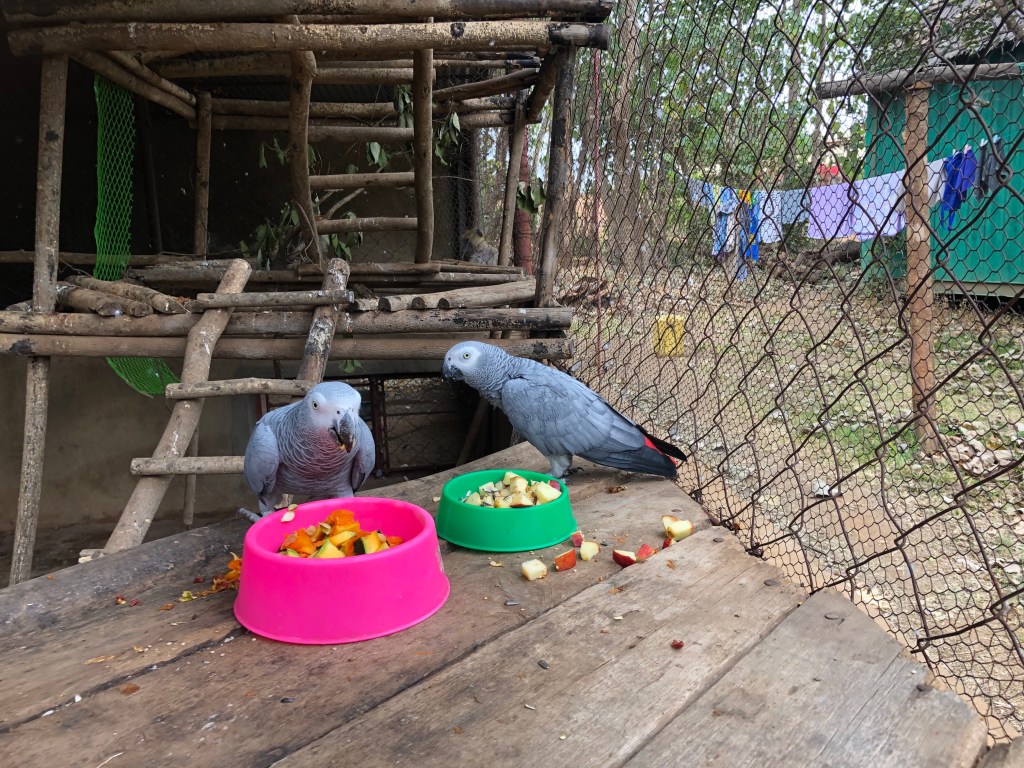
This morning we started our day distributing the medications to the long-term care patients. We will be responsible for doing this almost every morning before we start the rest of our day. Then, we fed Lulu and Beans, African Grey parrots. African Greys are not native to Malawi but are commonly kept as pets throughout Africa and in the US. Lulu was found in a hotel in Lilongwe while Beans was a pet who was surrendered when his owner was leaving the country. African Greys are extremely intelligent birds, as most parrots are, and these two can speak several Chichewa words. This is another species that enrichment is important for due to their intelligence. They are provided with a variety of perches of different sizes and textures to help them develop balance and keep their feet healthy. They are also given food in puzzles or boxes that they have to rip through with their beaks as they would in the wild.
Before lunch, we were responsible for feeding the two orphans that are currently at the center. Biscuit is a vervet monkey whose mother was killed when he was very young. Frankie is an orphan yellow baboon. The orphan protocol here involves the staff bottle feeding them for a short period of time. This teaches them that the bottle is where they feed from instead of a teat on a mother. Once they have gotten use to that, they are introduced to a foster mom of their species. It is important that they are introduced to a foster mom at a young age so that they can learn how to be a monkey and receive the social interaction that they desire. They are still fed from a bottle since their foster mom is not a lactating female, but the bottle can be placed on the enclosure and the orphan will go up and feed.
After lunch, we had a lecture on Pangolin Medicine with Charlotte. Pangolins are an extremely threatened animal in both Africa and Asia. Little is known about them because they are quite elusive do not survive well in captivity. They are the most trafficked mammal in the world both for their scales and for their meat. They have very unusual anatomy and a strict diet. They are considered myrmecophagic which means they eat termites and ants. Because of this diet, they do not have teeth but instead have a very long tongue similar to anteaters with sticky saliva that traps the ants.
Friday 5/28
After providing medication to the chronic cases, we performed a necropsy with Charlotte. Necropsies are the equivalency of autopsies in people. They are commonly performed after a euthanasia to determine underlying diseases that the animal may have had since advanced diagnostics are not always available or performed. We performed a necropsy on Yala, a 28-year-old vervet monkey. Yala presented for lethargy and weight loss. Upon examination, Charlotte found free fluid in her lung space (medical term: pleural effusion). Due to this finding and her advanced age, Yala was euthanized. On necropsy, we found a huge splenic mass, likely a hemangiosarcoma, and evidence of metastasis to a kidney and the lungs. These metastatic tumors in the lungs are likely what caused the pleural effusion.
After lunch, we were given time to work on our individual projects that we will complete during our time here. This is something that Lilongwe Wildlife Centre strongly encourages all externs to complete. In addition, I am working towards a certificate in International Medicine to supplement my DVM and a project is one of the requirements. I have decided to create educational posts that can be shared to a wide audience as my project. While I am here, in addition to my weekly updates, I will create an educational post about a selected topic. These posts will focus on species differences and the differences between medicine in the US and in Malawi. Each post will also contain a medical dictionary to translate everyday terms into the terms that we use in official medical documents and between veterinarians.
We are given Saturdays and Sundays off as time to relax, explore, and finish any project work we have from the week.
Monday 5/31
After administering medication to Boudicca, Ronnie, and Popcorn, we assisted Charlotte with a quarantine exam on Robert. Robert is an adult male baboon who was confiscated as a pet. Every animal that comes into the center spends at least 6 weeks in quarantine. This provides time to make sure that they do not have any infectious diseases, specifically tuberculosis. Each animal will undergo two quarantine exams, one on arrival and one before they are integrated into a troop. The exam includes a Rabies vaccination, tetanus vaccination, deworming, and a TB test. If the TB test comes back negative, Robert will be moved to a holding enclosure where he can interact with the other members of his future troop through fences. Since Robert is a large male, it could take up to 6 months for him to be accepted into the troop. Once they feel it is safe to introduce him, he will be released into the troop and eventually the whole troop will be released back into the wild.
In the afternoon, we were responsible for taking care of a baby bird that was brought in. This baby bird arrived with two siblings who were found after they had fallen from their nest. Unfortunately, the two siblings did not make it. We believe this bird is a mannikin, related to finches. Baby birds are quite needy when they are this young and we have to feed it every 30 minutes. This fledgling is now beginning to fly, and its eyes have opened. We believe it will survive to adulthood at this point but for now, we are serving as its mother and providing it with food because it cannot eat on its own.
Stay tuned for more exciting stuff happening this upcoming week and my first post for the International Certificate!


 Wandering Wildlife Vet
Leave a comment